
Designing for belonging
what King’s Cross Summer Sounds tells us about access, cohesion and wellbeing.
At Arts Trust, our ambition is not simply to programme live music. It is to reduce loneliness and isolation by making high-quality culture accessible to more people, especially those who face barriers to engaging with the arts, in the places where they live.
That means creating festivals such as King’s Cross Summer Sounds (KCSS), and St Osyth Summer Sounds that are free, welcoming and rooted in community. It also means treating community engagement not as an add-on to cultural programming, but as part of the method: listening carefully, working with local partners, and co-designing experiences that feel relevant, inclusive and open.
For arts practitioners, funders and commissioners, that raises two important questions. First, are we actually reaching the communities we most want to serve? Second, is there good evidence that this kind of community-centred cultural practice can strengthen connection, reduce isolation and support wellbeing?
Our latest postcode analysis of KCSS 2024 and 2025 gives us a strong answer to the first question.
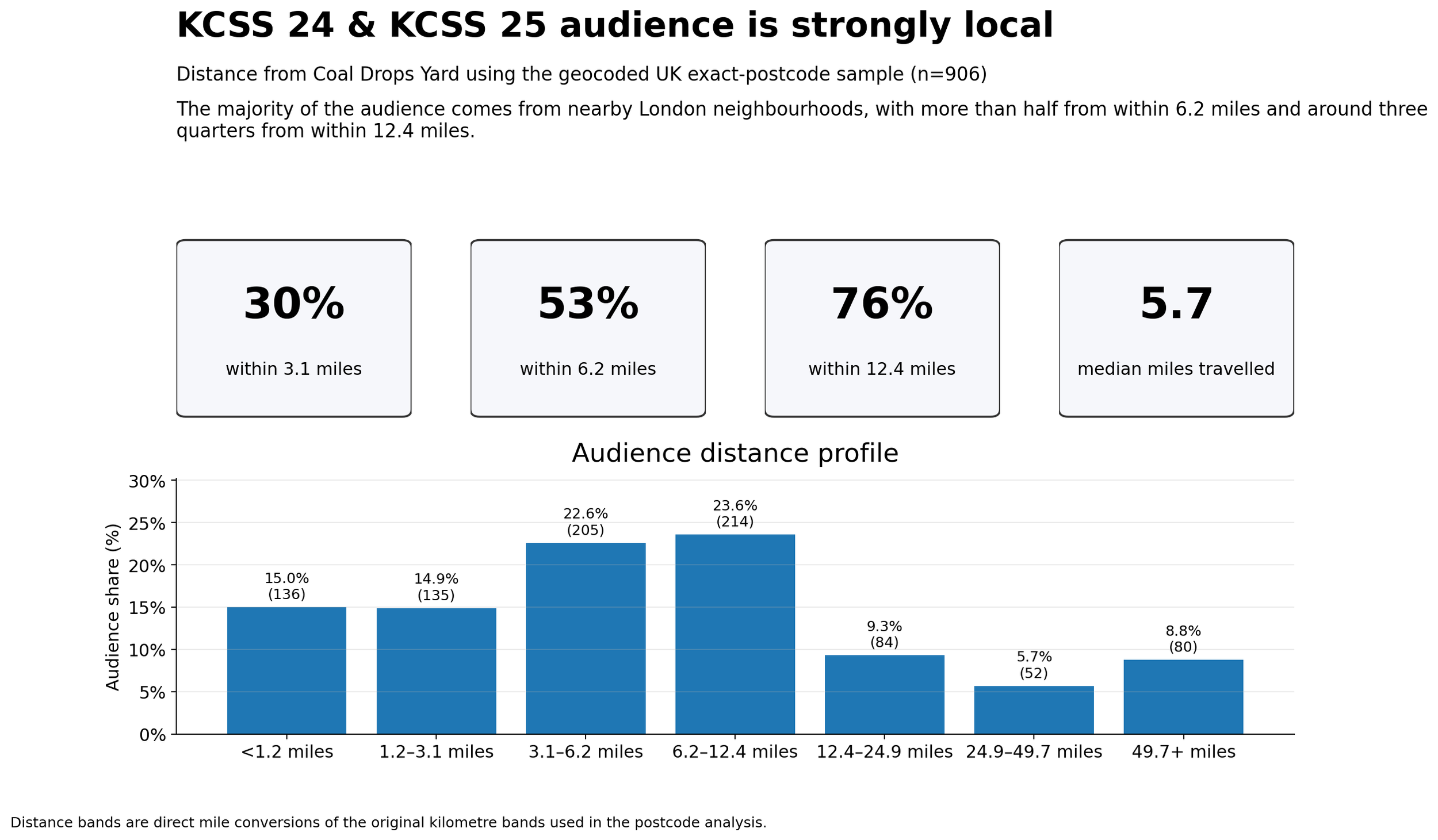
The clearest story in the data is that KCSS is genuinely local. The audience is overwhelmingly London-based, with a particularly strong concentration in north and inner London. The biggest audience clusters come from boroughs such as Islington and Camden, and postcode districts such as N1, NW1 and N7 stand out strongly. More than half of the exact-postcode audience sample across 2024 and 2025 came from within 6.2 miles of the festival site, and around three quarters came from within 12.4 miles. Therefore this is not primarily a destination audience. It is a local and city-regional audience, rooted in the neighbourhoods around King’s Cross.
That matters because widening access to the arts is not only about ticket price (our festivals are free). It is also about distance, trust, confidence, familiarity and whether cultural spaces feel like they belong to you. A free festival in a well-used public space can lower those barriers in ways that more formal cultural settings often do not. The postcode data suggests KCSS is succeeding in making live music part of everyday city life, rather than something experienced only by those already well served by the cultural sector.
The socioeconomic profile is equally important. Across the combined English full-postcode sample, 26.5% of audience postcodes fall within the most deprived 30% (IMD) of neighbourhoods in England, while 54.3% fall within the most deprived half. Only 24.5% fall within the least deprived 30%. Postcode data cannot tell us an individual attendee’s income, household situation or mental-health status. But it can tell us something meaningful about the places people are coming from. On that basis, KCSS is reaching a socially mixed audience and a substantial share of communities where disadvantage is more likely to shape everyday life.
This matters because loneliness, isolation and poor mental health are not evenly distributed. National evidence shows that loneliness is higher in more deprived areas, higher in urban areas, and significantly higher among disabled people. Mental-health need also follows a strong socioeconomic gradient. So when a free, community-rooted festival reaches more deprived urban neighbourhoods, it is more likely to be reaching places where the need for connection, belonging and low-barrier cultural participation is greater.
That gives us a robust first claim: KCSS is reaching the communities it most wants to reach.
But the more interesting question is what happens next.
Why co-design matters
There is a growing evidence base suggesting that place-based arts and culture can strengthen social relationships, belonging, pride of place and wellbeing. Community-based arts participation has been linked to improved social cohesion, and there is increasing recognition that co-creation and cultural participation can act as mechanisms through which wellbeing is strengthened.
For us, that matters because co-design is not simply a nice way of working. It is part of how trust is built. It is how people come to feel that a cultural space is genuinely for them.
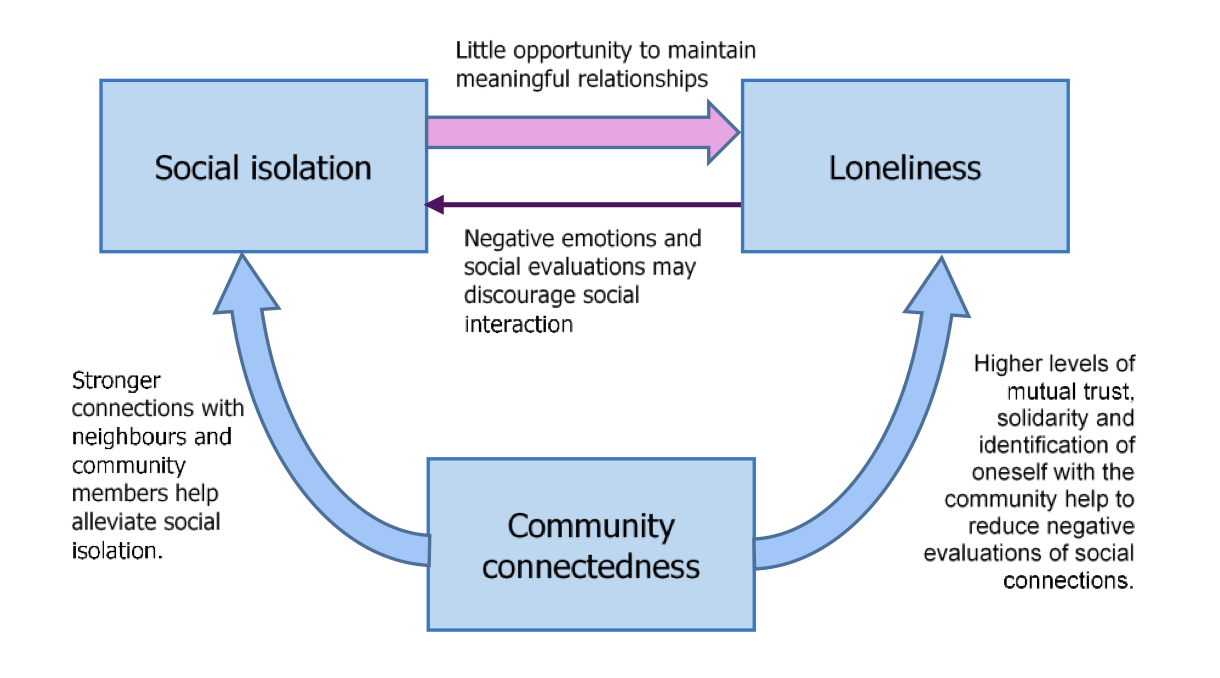
Social Isolation, Loneliness and Community Connectedness in Camden: Health Needs Assessment, 2022
That is particularly clear in our work with the PMLD community over the last three years. In partnership with Frozen Light, we programmed a bespoke production specifically for people with profound and multiple learning disabilities (PMLD) as part of the wider KCSS programme. This was not treated as a one-off piece of specialist programming. We committed to presenting the work over three consecutive years, because our aim was not just to host an accessible event, but to build a deeper and more sustained relationship with the community.
That long-term commitment shaped the work in important ways. Alongside the production itself, we supported the development of a community choir to take part in the show, and we carried out targeted outreach to local care homes and carers to encourage people with PMLD and their families to attend. We hosted the performance at Kings Place, an accessible local venue in Islington, as part of the wider festival ecology around KCSS.
The repeat commitment mattered. In years two and three, demand grew to the point where we had to increase the number of performances in order to accommodate all the requests for tickets. That is significant in itself. It suggests that trust, relevance and word-of-mouth confidence were building over time. Too often, cultural organisations expect communities who have historically been excluded to respond immediately to one-off invitations. In practice, participation often depends on consistency, relationship-building and visible signs that inclusion is being taken seriously over time.
At the same time, we expanded our wider access provision at the main outdoor festival site at Coal Drops Yard. That included access seating areas, induction loops and disability-awareness training for stewards and security staff. In other words, the bespoke work did not sit in isolation from the main festival. It informed the wider culture of the event.
One moment, in particular, has stayed with me.
In the second year of this initiative, a mother of a young person with PMLD came up to thank us for the care we had shown. I mentioned the bespoke show and suggested it might be suitable for her son. She told me she already knew about it, in fact, it was one of the reasons they had come to the festival in the first place.
When I asked why, she explained that seeing that work in the programme made her family feel seen. It signalled to her that the festival had thought about families like hers, that access had been taken seriously and that there would likely be provision for them across the site. That gave her the confidence to spend the time and energy it takes to attend a live event with her son. Interestingly, she also said that while the quieter, bespoke show was important, her son actually preferred the louder environment of the main festival. They have returned to KCSS each year since.
That anecdote does not stand in for formal evaluation. But it does illustrate something that arts practitioners often know intuitively and struggle to evidence convincingly: targeted inclusion work can change how people read an entire event. A specific intervention for one community can have a wider relational effect. It can communicate welcome, safety and credibility. It can create a bridge between a specialist offer and mainstream participation. And that bridge matters if the goal is not just attendance, but belonging.
From access to cohesion
This is where the postcode data and the lived-experience evidence begin to connect.
The postcode analysis shows that KCSS is reaching local, urban communities, including many living in more deprived neighbourhoods where loneliness, isolation and mental-health pressures are statistically more likely to be present. The PMLD work shows how intentional, repeated and community-specific programming can build trust and confidence over time, not only in the bespoke event itself but in the wider festival.
Taken together, they support a broader theory of change.
Free, community-rooted and co-designed music festivals can widen access to culture by reducing cost barriers and bringing activity into familiar local places. But they can also do something more relational. They can create low-pressure opportunities for repeated participation. They can help people feel recognised. They can build confidence in public cultural space. They can build shared experience between neighbours, carers, families, artists and audiences. They can connect communities to local social services. And in doing so, they can contribute to stronger community cohesion and to the conditions in which loneliness and isolation may be reduced.
The important phrase here is ‘contribute to’. We are not claiming that a festival alone can solve loneliness or poor mental health, nor that postcode data can prove an individual wellbeing outcome. But we are increasingly confident that investment in co-designed, free and community-focused music festivals is investment in the social conditions that support wellbeing: belonging, visibility, connection, confidence and shared space.
That distinction matters. The current evidence base is strongest when it comes to wellbeing, social connectedness and social cohesion. It is weaker when it comes to making direct causal claims about reducing mental illness or addressing structural inequality. So the sector needs to be both ambitious and honest: ambitious about the role that culture can play, and honest about the level of evidence we have at any given moment.
What the data tells us now, and what comes next
At this stage, the evidence from KCSS allows us to say three things with confidence.
First, the festival is reaching the communities it intends to reach: local London audiences, including audiences from more deprived neighbourhoods.
Second, the way the festival is designed matters. The strongest signs of impact are not only in the postcode distribution, but in the relationship-building: repeat programming, local partnerships, visible access provision and community-specific work that makes the wider event feel open and trustworthy.
Third, if we want to make a stronger case for the role of festivals in reducing loneliness and isolation, the next step is to gather deeper outcome evidence. That means moving beyond reach and into questions such as: Do people feel more connected after attending? Do they feel more confident returning? Are they more likely to attend with others, meet new people, or feel that local cultural space is ‘for them’? Do carers, disabled audiences and people facing barriers experience the festival as somewhere they belong?
Postcode analysis helps us understand who we are reaching. The next phase of evaluation needs to help us understand what changes because they came.
That is the challenge, and the opportunity, for Arts Trust and for the wider sector. If we want to argue that community festivals matter, we need to evidence not only attendance, but participation, belonging and change over time.
For us, the KCSS story is already clear. Investment in co-designed, community-focused music festivals is not simply investment in programme. It is investment in relationships. It is investment in visibility and trust. It is investment in the social fabric of a place.
And that is why this work matters.
Author: Martin Collins, PhD